
Dry Eye Disease (DED)
Dry eye disease is a chronic condition caused by insufficient quantity or unhealthy quality of tears to lubricate and nourish the outer surface of the eye.
Dry eye disease often goes undiagnosed and untreated, despite being a very common and treatable disease. The symptoms of dry eye disease are:
- itching
- burning
- foreign body or sandy or gritty feeling
- blurred vision
Dry eye disease is increasing as the population is aging. 20 and 25 million Americans suffer from varying degrees of dry eye disease.
Women are more prone to suffer from dry eye disease than men.
Dry Eye Overview
The eyelids both protect and lubricate the delicate front surface of the eyeball. Each blink of the eyelids spreads a thin layer of tears across the cornea and conjunctiva. These tears provide the following:
- lubrication between the lid and front surface of the eyeball
- reduce the risk of infection
- wash away foreign matter on the eyeball
- keep the surface of the eye smooth and clear
Tears are necessary to maintain the health of the ocular surface and to provide clear vision. People with dry eyes either do not produce enough tears or have a poor quality of tears.
Treatment attempts to replace inadequate tears or improve the quality of the tears.
What is the Tear Film?
When you blink, a film of tears spreads over the eye, making the surface of the eye smooth and clear. Without a healthy tear film, good vision is not possible.
The tear film consists of three layers:
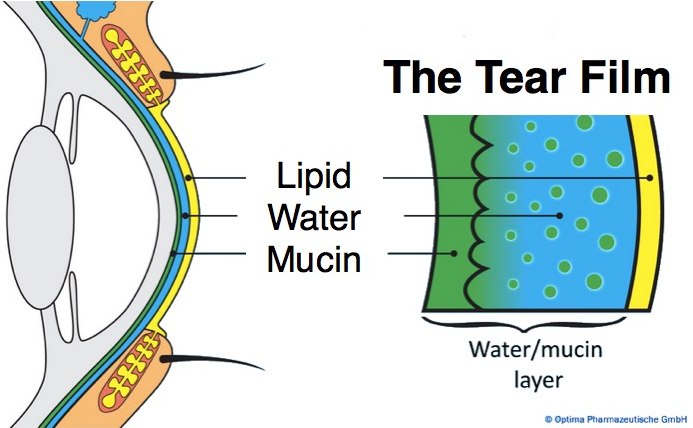
- Outer Layer - Lipid
- produced by the Meibomian glands in the eyelids. This oily layer creates a very smooth tear film surface and reduces evaporation of tears.
- Middle Layer - Water
- produced by the lacrimal gland under the upper lid. This is the thickest layer and cleanses the eye and washes out foreign particles or irritants from the surface of the eye.
- Inner Layer - Mucous
- produced by the conjunctival glands. Mucus spreads the water layer evenly over the surface of the eye and helps to keep the surface of the eye moist. Without mucus, the tear film would not stick to the eye.
Treatment Options for Dry Eye Disease
The goal of Dry Eye Disease treatment is to:
- Keep your eyes healthy
- Decrease the dry eye irritation and burning
- Prevent your vision from being affected.
These goals are usually achieved with a combination of different treatment options.
The NanoTears® Solution
NanoTears® support all three parts of the tear film - the lipid, water, and mucin compartments of the tear film.
These nano-sized polar and non polar lipids, called NanoPids support the lipid layer, helping to stabilize the tear film to reduce evaporation, prolong tear film breakup time, and reduce osmolarity.
- During the day -
- use NanoTears® 4-6 times in each eye when your eyes are burning, stinging, or feeling scratchy. The drops may be used as often as your symptoms require.
- At Bedtime -
- is a good time to put one last drop of NanoTears® in each eye.
NanoTears® available at Genstler Eye Center
NanoTears® are OTC drops and can be purchased at Genstler Eye Center.
Three different NanoTears® formulations:
- NanoTears® TF -
- Mild dry eye disease
- NanoTears® XP -
- Moderate dry eyes disease
- NanoTears® MXP -
- Severe dry eyes
Other Artificial Tear Solutions
There are many Artificial Tear solutions available on the market today. These can be used as often as needed to supplement natural tear production.
Artificial Tear Ointments
Severe dry eyes may benefit from the use of artificial tear ointments which are also available over the counter.
Ointments are best used at night just before going to bed. Most patients experience some blurring of their vision when you wake up in the morning, since ointments stay in the eyes longer than drops. It is not advisable to use artificial tear ointments during the day or while driving.
Warm Compresses to the Eyelids
Warm compresses, masks and lid massage, or eyelid cleaners help decrease eyelid inflammation and increase tear production.
Punctal Plugs
The tears drain out of the eye through the tear ducts. The tear duct opening is called the puncta. Very small silicone or gel-like punctal plugs can be placed in the eyelid puncta to block the flow of tears from the eye into the nasal lacrimal drain.
The puncta can be permanently closed surgically if the plugs are effective, but they fall out and need to be frequently replaced.
In either case, the goal is to keep the available tears in the eye longer to reduce problems related to dry eye disease.
Omega-3 Essential Fatty Acids
Omega-3s are essential fatty acids (EFAs) that are anti-inflammatory in nature and they aid in the reduction of inflammation of the lacrimal glands, leading to better tear production and improvement of dry eye disease.
Eye Omega Advantage® is custom formulated with a synergistic blend of critical eye nutrients with the highly beneficial Omega-3 essential fatty acids as well as Vitamin D3 for additional comprehensive health benefits. The combination of these nutrients helps support healthy vision and optimal eye health. It can be found here.
Other Simple Solutions for Dry Eye Disease
Solutions that minimize factors that cause or exacerbate dry eye disease.
- Avoid air blowing in your eyes. Don’t direct hair dryers, car heaters, air conditioners or fans toward your eyes.
- Wear glasses on windy days and goggles while swimming. The wraparound style of glasses may help reduce the effects of the wind.
- Wear glasses on windy days and goggles while swimming.
- Add moisture to the air. In winter, a humidifier can add moisture to dry indoor air. Some people use specially designed glasses that form a moisture chamber around the eye, creating additional humidity. These glasses can be worn at night, and may be especially helpful for people that sleep with their eyes partially open. They can also be worn during the day to relieve dry eye symptoms.
- Avoid rubbing your eyes. You can irritate your eyes further by rubbing them.
- Take preventive steps. Use eye drops before, rather than after the symptoms begin; your eyes become irritated as a result of visually demanding activities. Try to avoid activities that might worsen the problem.
- Remember to blink. Consciously blinking repeatedly helps spread your own tears more evenly. When performing tasks that require intense visual concentration, take occasional breaks and rest your eyes by closing your lids for several seconds.
- Avoid smoke. Smoke, whether yours or someone else’s, can contribute to dry eyes.
- Avoid anti-histamine or other allergy medications: Often these medications are designed to ‘dry up’ your nose; they tend to dry your eyes at the same time.
- Stay hydrated by drinking plenty of water regardless of the season: If you are dehydrated, your eyes become dry.
Drink at least half your body weight in ounces of water each day.
If you our weight is 140 lb = Drink 70 oz of water or Seven (7) 10 oz glasses of water